STRATEGY —
Stop Paying Off the Loan
Before a sale, early debt paydown moves cash to the wrong side of the multiple.
TL;DR: Every dollar you deploy in the two or three years before a sale lands on one of two sides of a line. Inside the multiple, where it gets counted several times over in the price. Or outside it, where it just leaves. Paying down debt faster than you have to is the most respectable way there is to move money to the wrong side of that line.

The Reflex
We are trained as owners to be fiscally responsible, and for most of us that training arrived early and stuck hard. Debt is a weight. You retire it as fast as you can. Every extra payment feels like progress, and it looks like progress on the balance sheet, and nobody has ever been criticized in a board meeting for paying off a loan ahead of schedule.
I am not telling you to default. Make the payments. What I am telling you is that in the window before a sale, minimum payments are the correct payments, and the excess belongs somewhere else.
Inside the Multiple, or Outside It
Here is the line.
Your business sells for some multiple of its earnings. Call it five, call it eight, the exact number does not matter for this. What matters is that a dollar of additional annual profit is not worth a dollar at closing. It is worth five dollars, or eight, or whatever your multiple happens to be.
So run the two paths.
Path one: you take a hundred thousand dollars of excess cash and retire a hundred thousand dollars of principal early. Your balance sheet improves by a hundred thousand dollars. At closing, your buyer nets that against the purchase price and you get back roughly what you put in. One dollar for one dollar. The multiple never touches it.
Path two: you take the same hundred thousand and put it into something that produces earnings. An acquisition that adds to the company's value. Marketing that grows the customer base. A profit-making asset. If that hundred thousand adds fifty thousand dollars of annual profit and you sell at six times, it added three hundred thousand dollars to the sale price. It also earned you the profit along the way.
Same cash. One path gets counted once, the other gets counted six times.
The Trap Inside the Trap
There is a second condition on this, and skipping it is how founders turn good advice into an expensive mistake.
The money has to land inside the window.
If you spend a million dollars on a growth initiative that takes two years to realize, and you sell in eighteen months, that money is essentially lost to you. The next owner gets the benefit. You paid for the runway and somebody else took the flight. Anything that reduces your profits reduces your sale price, and an initiative that is still burning cash at closing is doing exactly that.
Which is also why the window before a sale is not the time to introduce a risky new product line or expand into a bigger office. Both feel like growth. Both are cash going out with the payback landing after your name comes off the door.
The test is not "is this a good investment." The test is "will this be visibly producing profit by the time a buyer is looking at my trailing twelve months."
What I Would Actually Do
Three buckets, in this order.
Minimum debt service. Not a dollar more than the schedule requires.
Then profit-making assets and capital expenses, the things that show up in earnings quickly rather than eventually.
Then acquisitions and marketing that add customers or add entities, both of which land inside the multiple and both of which keep paying whether you sell or not.
That last part is the honest reason to do this even if your timeline slips. None of these moves are exit-specific. They are what a well-run business does with excess cash in any year. The only thing the exit window changes is how expensive the alternative becomes.
You have $100k of excess cash in the business right now. Where does it actually go?
— Roland

Thinking About Exiting Your Business?
What Would Buyers See If They Evaluated Your Business Today?
Your Exit-Ready Score reveals the hidden risks that suppress valuation, built on the same indicators private equity uses to screen deals in under 5 minutes.
Find out your score….

Want more than just the weekly deep dives?
On Instagram we share quick tips, behind-the-scenes looks, and first access to what’s coming next.
Follow @RolandFrasier on Instagram and join the community.

Roland’s Riff
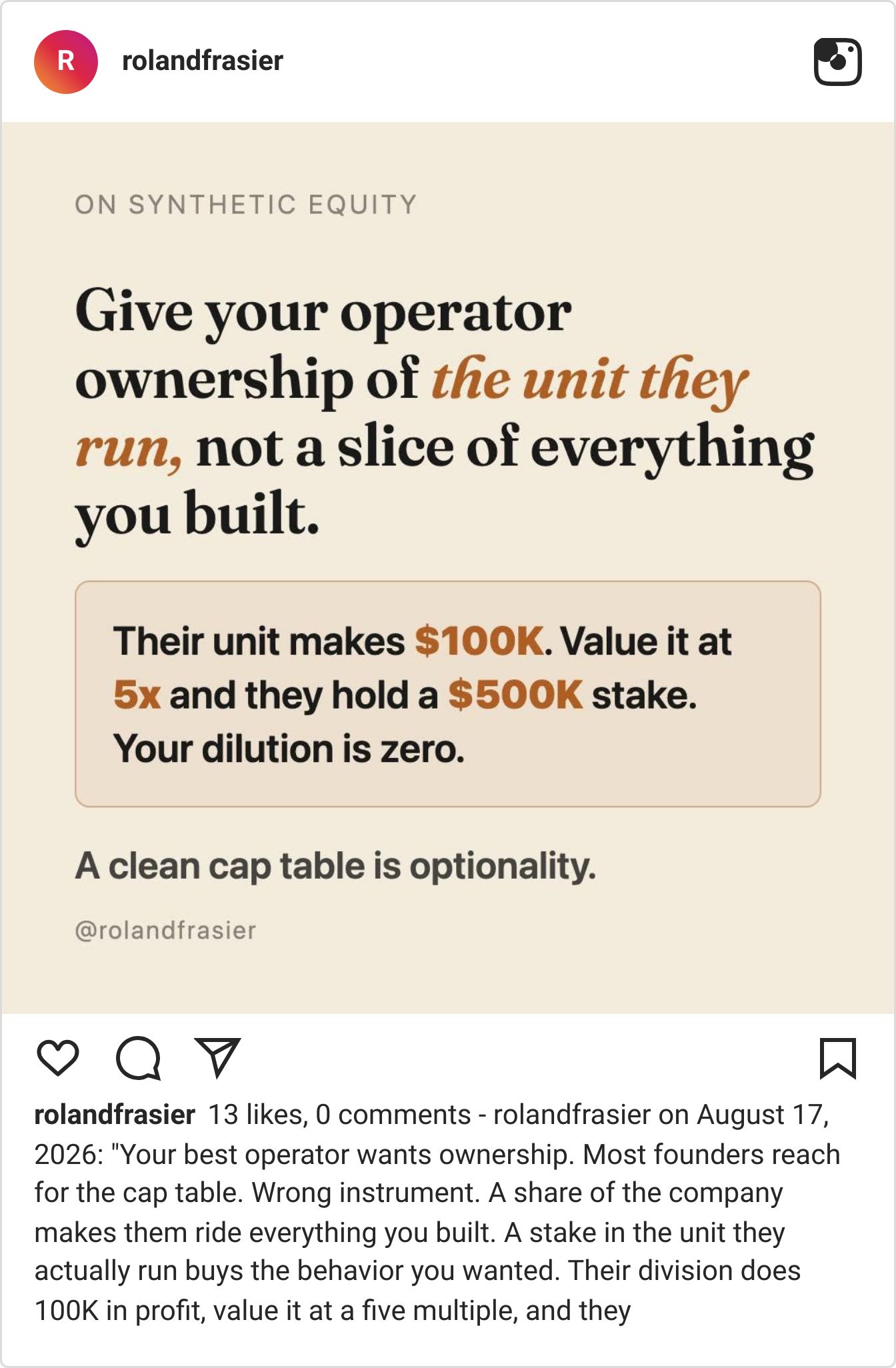
Your best operator probably wants ownership.
That doesn't mean they need equity in your company.
Most founders assume the only way to create long-term alignment is by giving away pieces of the cap table.
There are often better ways. The goal isn't just to reward great people.
It's to create incentives that make them think, decide, and act like owners, without creating unnecessary complexity for your business or your eventual buyer.
The structure matters just as much as the incentive itself.