STRATEGY —
Build It to Be Absorbed
The most valuable business isn't a fortress. It's one a buyer can absorb fast.
TL;DR: Founders build for defense. They want a business so distinctive no one could copy it. Buyers want the opposite. The companies that command premiums and the widest bidding aren't the ones hardest to replicate; they're the ones easiest to absorb. Clean books, documented processes, real managers, systems a platform can plug in within six months. Integration cost is an invisible line item in every offer, and most owners inflate it without knowing. The lever almost no seller touches is designing the business to be acquired, not just to be admired.

The Business That's Easy to Buy
Most founders, if they think about being acquired at all, build for defensibility. They want a business so distinctive, so hard to copy, that a buyer has no choice but to pay up. It feels like the right instinct. It's half the picture, and often the wrong half.
Because the buyer isn't only asking "could I replicate this?" They're asking a quieter, more expensive question: once I own it, how hard is it to absorb? That second question moves the price more than founders ever realize.
Integration Is the Cost You Never See on Your P&L
Here's the mechanic. When a serious acquirer, a private equity platform or a strategic, looks at your company, they aren't buying it to admire it. They're buying it to fold it into something. New accounting system, new reporting, new payroll, new chart of accounts, their governance laid over your operation. Every place your business is idiosyncratic, that folding gets slower and more expensive.
The sophisticated ones now put a number on it before they ever sign. They run what amounts to a Day-180 integration map: can we have this company on our systems, our reporting, and our org structure within six to twelve months, at a cost we can predict? If they can't see that path, they don't pay full price. They reprice, or they pass. The integration cost comes straight out of your multiple, and you never see the line item. You just see a lower number and assume the market was soft.
You're Not Selling a Business. You're Selling How Easily It Bolts On.
So flip the question every founder asks. It isn't "what makes my business special." It's "what makes my business expensive to absorb," and then you go remove those things.
The expensive-to-absorb business runs on the founder's head. The customer relationships live in your phone. The real numbers live in a spreadsheet only you can interpret. Knowledge is tribal, processes are unwritten, the entity structure has three legacy LLCs nobody remembers creating. None of that makes the business worse at making money. All of it makes the business harder to hand over, and a buyer prices the handover, not the love you have for what you built.
The easy-to-absorb business is the mirror image. Books a buyer's accountant can verify without rebuilding them. Processes written down well enough that the work survives the founder walking out the door. A layer of managers who already run the place and can report into a new parent on day one. Customers who belong to the company, not to you personally. That business isn't necessarily more profitable. It's radically cheaper to own, and the widest, deepest pool of buyers will pay for that.
Absorbability Sets Your Price and Your Freedom
This cuts two ways, and both favor the owner who builds for it.
First, the price. A business a platform can plug in cleanly attracts more bidders, and more bidders is the only thing that reliably lifts a multiple. You're not begging one buyer to see the upside; you're letting several of them compete because none of them fear the integration.
Second, your exit on the way out. When the business is absorbable, the buyer doesn't need you chained to a three-year employment contract to keep the lights on. They'll take a light-touch consulting agreement instead, which means more of your money up front and your time back sooner. The same thing that lifts the price buys your freedom. Founder-dependence does the reverse on both counts: lower price, longer leash.
How I'd Do This
If this were my business and I had any thought of selling inside the next few years, I'd stop building to impress and start building to hand over. Same company, different target.
There are four things a buyer quietly prices and most owners never touch, so I'd fix all four. Books an acquirer's accountant can verify without rebuilding them, on a real system, reconciled. The processes that live in my head written down well enough that the work survives me walking out the door. A layer of managers who already run the place and can report to a new parent on day one, not me lightly disguised. And the customer relationships and the numbers moved off my phone and out of my one spreadsheet into a system the buyer inherits clean.
None of that makes the business better at making money this quarter. All of it makes the business cheaper to own. Cheaper to own is what a wider pool of buyers bids up.
I'd start years early, because you can't manufacture absorbability in the ninety days before a sale. It's built, not staged. Do it ahead of time and I walk into the room with more bidders, a higher multiple, and a shorter leash on the way out. Do it late and I'm explaining a spreadsheet to a stranger while the offer drops in real time.
The founders who sell well aren't the ones who built something no one could copy. They're the ones who built something a buyer could own the morning after the wire clears.
— Roland

Want more than just the weekly deep dives?
On Instagram we share quick tips, behind-the-scenes looks, and first access to what’s coming next.
Follow @RolandFrasier on Instagram and join the community.

Thinking About Exiting Your Business?
What Would Buyers See If They Evaluated Your Business Today?
Your Exit-Ready Score reveals the hidden risks that suppress valuation, built on the same indicators private equity uses to screen deals in under 5 minutes.
Find out your score….

Whats Going On Recently
Keep More Of Your Money: PRIME can show you how to protect yourself, grow assets, build business funding, and how to take advantage of 250+ unique tax deductions.

Zero Down Book | Free Copy
This Book Reveals Little-Known Wall Street Insider Strategy To Quickly Acquire Profitable Businesses Worldwide, Without Using Your Own Money or Credit...

Roland’s Riff
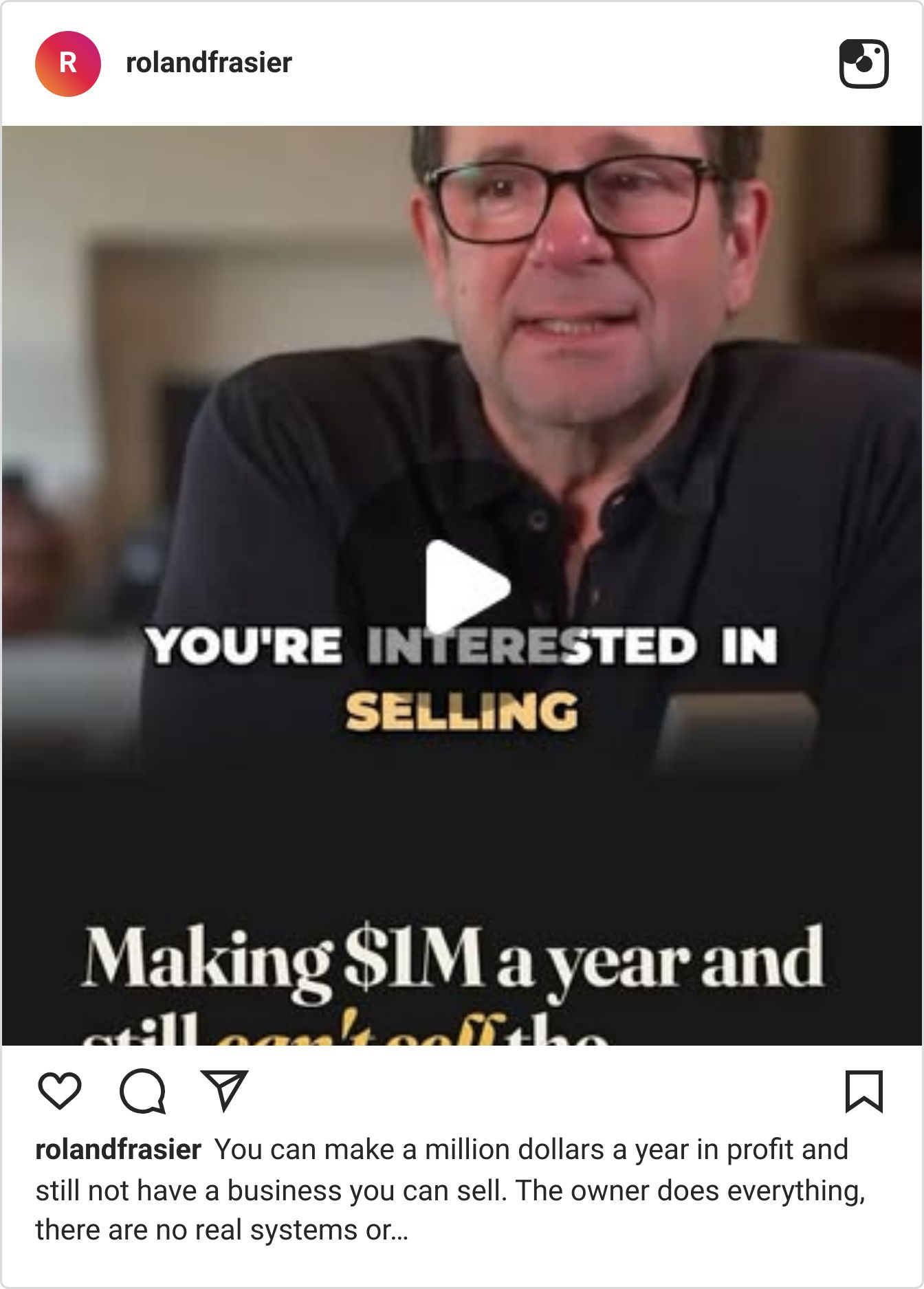
You can make $1 million a year... and still own a business that's almost impossible to sell.
Profit alone doesn't create value.
Buyers aren't just evaluating your financials. They're asking one question:
What happens if you disappear tomorrow?
If the answer is "everything stops," you're not selling a business.
You're selling a job that happens to produce great income.
The companies that command premium valuations have one thing in common: they no longer depend on the founder to keep the engine running.
That's the difference between building an income... and building an asset.
Want to see why making yourself less essential can dramatically increase your company's value? Watch the video below.