STRATEGY —
Golf Won't Save You
The standard post-exit advice is wrong about what you'll actually miss.
TL;DR: The usual advice for the void after an exit is to build a life outside the business: hobbies, travel, get the golf handicap down. Roland's position, on the record, is that this advice fails actual entrepreneurs, because those activities scratch a different itch than building did. The real fix isn't a new hobby. It's naming the one specific mechanism inside the old work that produced the fulfillment, then finding it a new home before the wire clears.

The Advice That Doesn't Work for You
Every post-exit guide says some version of the same thing. Build a life outside the business. Take up something new. Travel more. Get serious about golf.
The people I know who've actually retired from real entrepreneurship are bored out of their minds by all of it. The racing team they put together. The golf they're trying to get down to scratch on. The travel. None of it is enough, because it scratches a different itch. The builder energy, the deal-maker energy, the fray of actually making something happen, that isn't replicable. It doesn't show up in any of those other things.
I include myself in this. I like the idea of stepping back, but I would absolutely miss the battle. Not battle in an ugly sense. I mean the negotiation itself.
Why the Hobby Never Lands
This isn't a complaint about hobbies being boring. It's a category error. A hobby is a substitute for an activity. What you're actually losing isn't an activity, it's a mechanism, a specific way you were engaging with risk, people, or a problem that produced the sensation you're now missing. You can fill every hour of the week and still feel the exact same hollowness you were trying to fix, because volume was never the thing that was missing.
Which means the fix isn't finding something else to do with your time. It's figuring out what it was about running the business that actually created the fulfillment, because "owning a business" is not a specific enough answer to replace.
For me it's the negotiation. For my business partner Ryan, it's something else entirely: the zero-to-one part, getting a new idea moving, building the early systems around it, and then handing it off. Once that handoff happens, he told me flatly, the thing is dead to him. He has no interest in running what he built.
Our other partner Richard is different again. He'd be perfectly happy walking into a room full of people he gets to direct. He likes being the conductor. Give him people to organize and he's fulfilled, full stop.
Three people, same company, three completely different answers to what actually mattered. None of us would have guessed the other two's answer before we said it out loud, and none of us could borrow one of the other two answers and expect it to work. My version of Richard's fulfillment would bore me the same way golf does.
If you sold tomorrow, which specific part of running the business would you actually miss?
The Question That Actually Matters
So the useful question before you sell isn't "what will I do after." It's narrower and harder: which specific mechanism, not the business as a category, but the actual thing inside it, is doing the work right now. The negotiation. The zero-to-one build. The room full of people you get to direct. Something else entirely.
Find that answer honestly, and you can go build a real vehicle for it before you ever sign anything. Skip that question and take up golf instead, and you'll have plenty of time to notice exactly what you didn't replace.
If naming your own version of that answer is harder than it sounds, the 5 Evolutions assessment is built around the same idea: it maps which stage of the operator-to-owner arc you're actually in, free, in a few minutes.
— Roland

Want more than just the weekly deep dives?
On Instagram we share quick tips, behind-the-scenes looks, and first access to what’s coming next.
Follow @RolandFrasier on Instagram and join the community.

Thinking About Exiting Your Business?
What Would Buyers See If They Evaluated Your Business Today?
Your Exit-Ready Score reveals the hidden risks that suppress valuation, built on the same indicators private equity uses to screen deals in under 5 minutes.
Find out your score….

Roland’s Riff
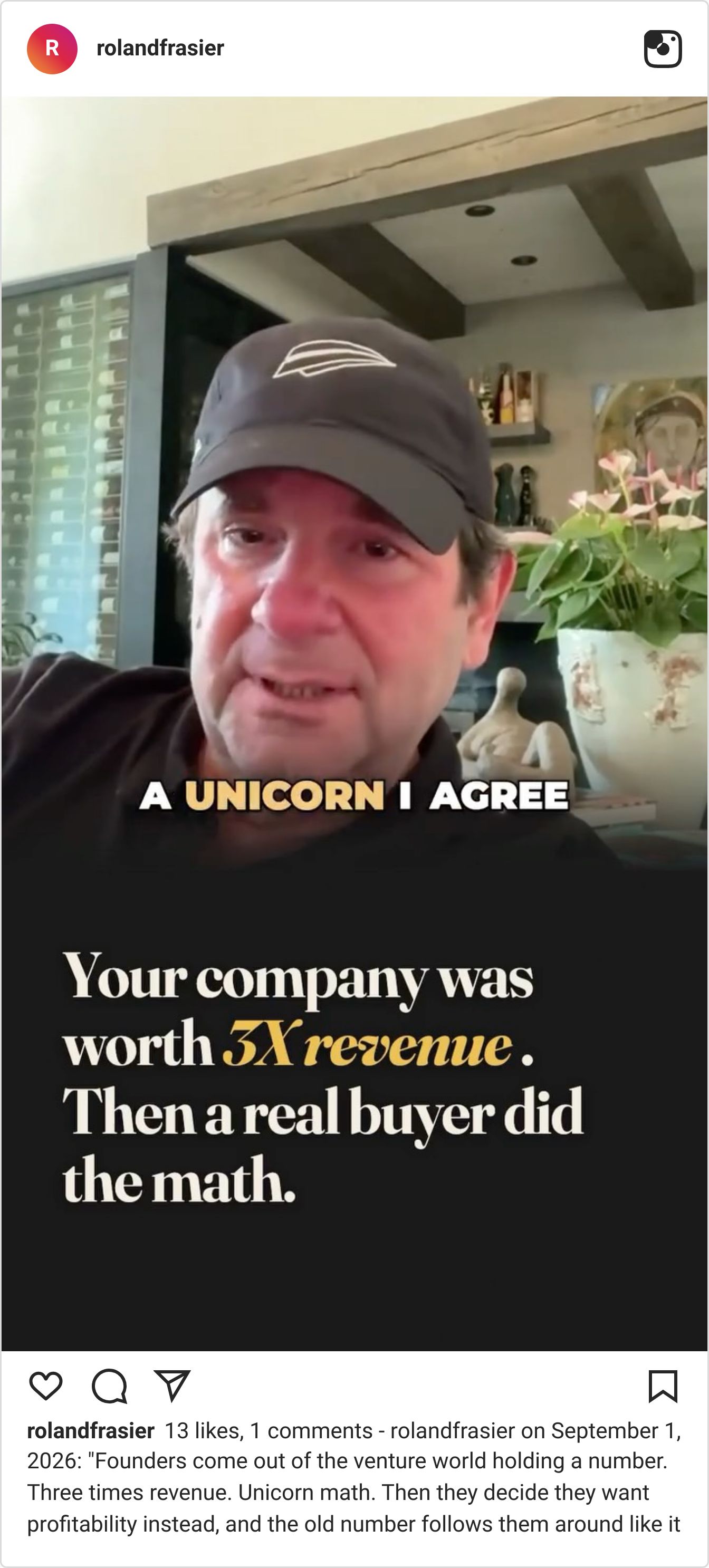
Your company isn't worth what it was worth in your last business model.
This catches a lot of founders coming out of the venture world.
They were taught to think in revenue multiples, growth curves, and the valuation they could reach.
Then they build a profitable company and assume the same valuation logic still applies.
It doesn't.
The moment you change the kind of business you're building, you change the market that determines what it's worth.
Different buyers. Different metrics. Different expectations.
And potentially a very different number.
Want to see why changing your business model can completely change your valuation?