STRATEGY —
The Discount Runs Both Ways
The thing that gets you discounted is the thing that was working.
TL;DR: Founders already know a business that can't run without them takes a valuation hit at close, but they rarely see the other half of that trade: buyers underwrite the discount, pay for the dependency anyway, and then remove it. The founder gets replaced with a hired executive who has none of the skin in the game that made the business worth buying in the first place. The discount doesn't disappear at closing; it moves from the price to the performance, and somebody still pays it.

The Discount You Already Know About
If your business can't run without you, buyers price that in. It shows up as a lower multiple, a longer earnout, a bigger holdback, sometimes all three stacked on top of each other. I have sat across the table from founders who did everything right operationally and still watched the number shrink because every important relationship, every judgment call, every piece of institutional memory ran through one person. Most founders in the middle of an exit process have made peace with this. You built something that depends on you, the market knows it, and you pay for it at the table.
That part is not controversial. Every serious buyer runs some version of this discount, and every experienced seller has heard some version of the lecture. What almost nobody accounts for is what happens after the table, once the wire clears and the org chart gets rewritten.
What Buyers Actually Do With What They Bought
Private equity will replace the founder. Not sometimes. As a matter of course. And the replacement is rarely another entrepreneur. It's an MBA, often straight out of a program, often with McKinsey or a bank on the resume. Quant smart. Not street smart.
That person will not hustle like an owner with skin in the game, because they aren't one. They're an employee. They don't typically have the vision, because they haven't lived the thing they were hired to run. They're not going to work seventy-hour weeks for a company that was never theirs. None of that is a knock on them personally. It's just what the arrangement is.
And that hidden asset, the scrappy, unreasonable, slightly irrational hustle that built the company, is the single most missed thing when a founder sells. Not missed by the founder. Missed by the buyer, in the underwriting.
The numbers back this up better than most buyers would like. Academic research on large private equity buyouts found roughly two-thirds of the new CEOs installed after a deal were complete outsiders to the company, and researchers who study founder succession broadly put the failure risk on those transitions at two to three times a normal handoff. PE's own executives have noticed. In one recent industry survey, sixty-five percent of firms reported a CEO change during their hold, and the majority of those same executives said the turnover cost them time and, in nearly half of cases, cost them returns.
This is not a rare misfire buried in a footnote. It is closer to the default outcome of the model, and the firms running the model know it and keep running it anyway, because the alternative, leaving the founder in place indefinitely, creates a different kind of risk they like even less.
That is worth sitting with. The people writing eight and nine figure checks, with entire teams dedicated to diligence, are still getting this wrong at scale. If they are missing it with every resource in the world pointed at the problem, the odds that a smaller strategic buyer with none of that infrastructure is pricing it correctly are not good.
Systems Don't Replace a Force
Buyers and their advisors will tell you the fix is systems. Document everything, build the team, make the business "run without the founder," and the risk goes away. There's truth in that, and it's also incomplete. A system transfers a process. It does not transfer a force.
Apple, Amazon, and Tesla did not grow the way they grew on the strength of their org charts. They grew because someone unreasonable was pushing on every part of the machine at once, in a way no employee, however capable, was ever going to replicate on salary. Systems make a business survivable without its founder. They do not make it grow the way it grew with one.
This is where the standard sell-side advice runs out of road. Founders are told to systemize themselves out, and that advice is correct as far as it goes: an undocumented, founder-dependent business is genuinely harder to sell and genuinely more fragile. But systemizing yourself out solves for survivability, not for growth, and buyers routinely confuse the two.
They diligence the systems, confirm the business can run without you, and treat that as confirmation the business will keep performing without you. Those are different claims, and the gap between them is exactly where the underperformance shows up two and three years into the hold.
Why This Matters More Than the Multiple
Here is the asymmetry worth sitting with. The market is quite good at pricing founder dependency out of your side of the deal. It is much worse at pricing it back in on the buyer's side, which is exactly why the failure rate on these transitions keeps surprising the people writing the checks.
If you are selling, this is not a reason to feel better about a discounted offer. It is information. The buyer who is discounting you hardest for dependency is frequently the same buyer least prepared for what disappears when that dependency leaves the building. That is a legitimate thing to raise in diligence, and a legitimate reason to care who you sell to, not just what they pay.
If you are the one doing the buying, and a fair number of you reading this are, because acquisition is how a lot of you scale, the lesson runs the other direction. The discount you negotiated for founder dependency was never free money. It was a warning label on the part of the business you were about to remove, and the discipline is to decide, before you sign, exactly what you are going to install in place of the thing you priced out. Not a system that lets the business survive the transition. A person, a structure, or an incentive that actually replaces the force, not just the process.
My Perspective
The goal was never to make yourself the irreplaceable center of the business. That is the trap on the other side of this same coin, and it is its own kind of discount, paid in the form of your own trapped optionality.
The goal is to know exactly what you're worth to the machine while you're still standing in it, and to make sure that whoever inherits your seat, whether that's a hired executive, a partner, or nobody, understands that some of what you did was never in the systems at all.
That is not a case for staying irreplaceable. It's a case for being honest about which parts of you were actually the product.
— Roland

Want more than just the weekly deep dives?
On Instagram we share quick tips, behind-the-scenes looks, and first access to what’s coming next.
Follow @RolandFrasier on Instagram and join the community.

Thinking About Exiting Your Business?
What Would Buyers See If They Evaluated Your Business Today?
Your Exit-Ready Score reveals the hidden risks that suppress valuation, built on the same indicators private equity uses to screen deals in under 5 minutes.
Find out your score….

Roland’s Riff
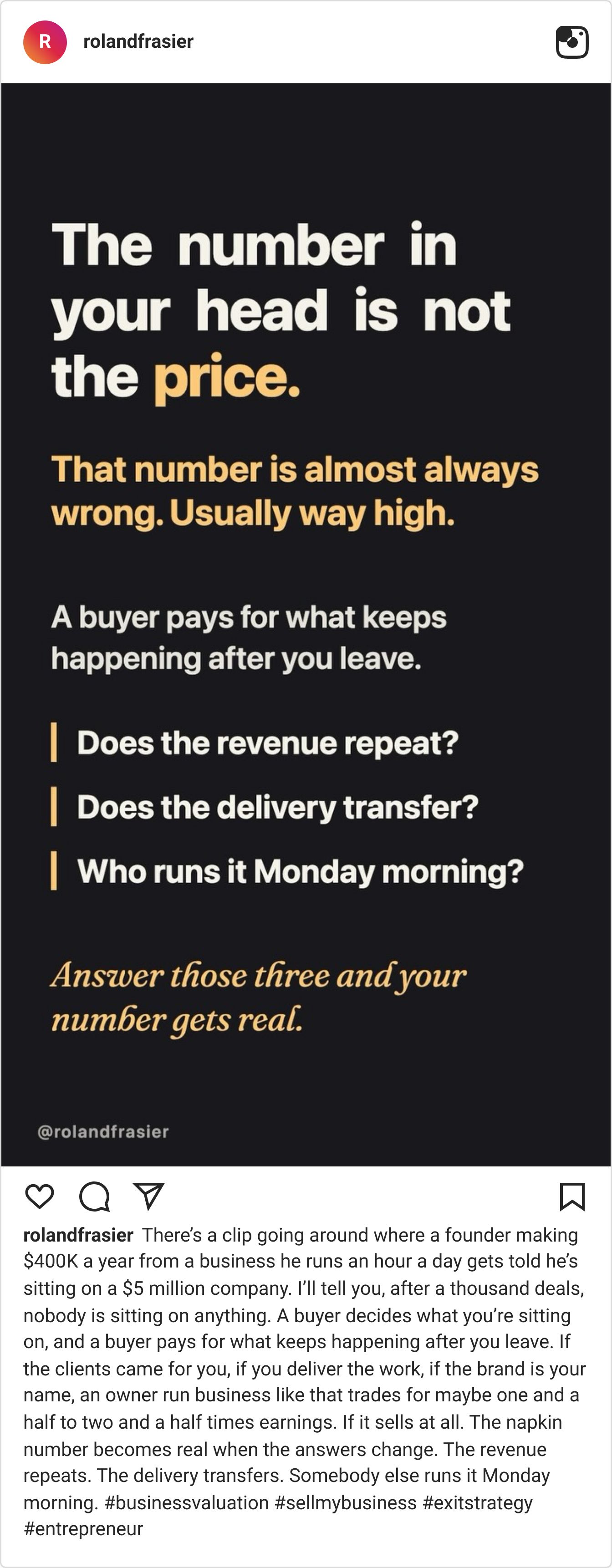
Nobody is “sitting on” a $5 million business.
The buyer decides what your business is worth.
And they aren't just looking at how much money it makes today.
They're looking at what happens the Monday morning after you leave.
Does the revenue keep coming?
Does the work still get delivered?
Does the company still function without the person who built it?
A business can produce incredible income for its owner and still be worth far less than they expect when it comes time to sell.
The difference between a great-paying job and a valuable asset is what survives without you.