STRATEGY —
Growth Is Hiding Your Worst Decisions
Every plateau feels like a new problem. It is the same one in a new costume.
TL;DR: Founders read a rising top line as proof the business is sound. It rarely is. Growth does not fix the thing holding you back. It hides it, then swaps it for a bigger one. The founder dependency that capped you at two million becomes the missing leadership bench at ten, becomes the undocumented operating system at thirty. Same defect, new costume. Buyers keep a name for the list, the eleven value killers, and growth only lets you outrun them for a while. It never makes them go away.

Every founder treats a rising top line as a verdict.
Revenue is up, so the machine works, the team is right, the decisions were sound. Growth reads like proof.
It rarely is. Growth does not fix the thing holding a business back. It hides it, and then, quietly, it swaps it for a bigger one. The problem never really leaves. It changes costumes.
Watch how it moves. Early on, the constraint is you. The business runs on your relationships, your judgment, your willingness to touch everything, and you grow anyway, because a founder working eighteen-hour days can push a small company a long way. Then you hit the ceiling of your own capacity, so you hire, and the constraint moves.
Now it is the bench.
A buyer asks who runs finance and the honest answer is you. You solve that, and it moves again, to the fact that nothing is written down, that the whole operation lives in a few people's heads. Roland calls that an ancient civilization, not a company. Every stage has a different defect, and at every stage growth papers over it just long enough for you to mistake motion for health.
Buyers are not surprised by any of this. They have seen it too many times to be surprised. They keep a list, roughly eleven items long, of the things that quietly suppress what a business is worth.
Founder dependency. No leadership bench. No documented system. Revenue that lurches around like an EKG a cardiologist would not like. Recurring revenue that turns out not to recur. One customer who is a third of the book. The list barely changes from deal to deal, because the defects barely change from business to business. What changes is which one is currently doing the damage in yours.
That is the part growth obscures. When the top line is climbing, every one of these looks like tomorrow's problem, because there is always a bigger number arriving to make today's mess feel temporary. So the dependency does not get fixed, it gets outgrown, which is not the same thing. The undocumented process does not get written down, it gets buried under volume. The concentration does not get diversified, it gets larger in absolute dollars while you tell yourself the percentage will sort itself out. None of it is solved. All of it is deferred, and deferral compounds.
The founders who build genuinely valuable companies are not the ones who grew through their problems.
They are the ones who noticed that the problem at each new level was the same problem in a different suit, and who fixed the underlying thing instead of outrunning it one more quarter.
They stopped reading growth as a verdict and started reading it as an anesthetic. Useful, sometimes necessary, but an anesthetic is not a cure. The thing it is numbing is still there when the growth slows and everyone finally has to look.
— Roland

Thinking About Exiting Your Business?
What Would Buyers See If They Evaluated Your Business Today?
Your Exit-Ready Score reveals the hidden risks that suppress valuation, built on the same indicators private equity uses to screen deals in under 5 minutes.
Find out your score….

Want more than just the weekly deep dives?
On Instagram we share quick tips, behind-the-scenes looks, and first access to what’s coming next.
Follow @RolandFrasier on Instagram and join the community.

Roland’s Riff
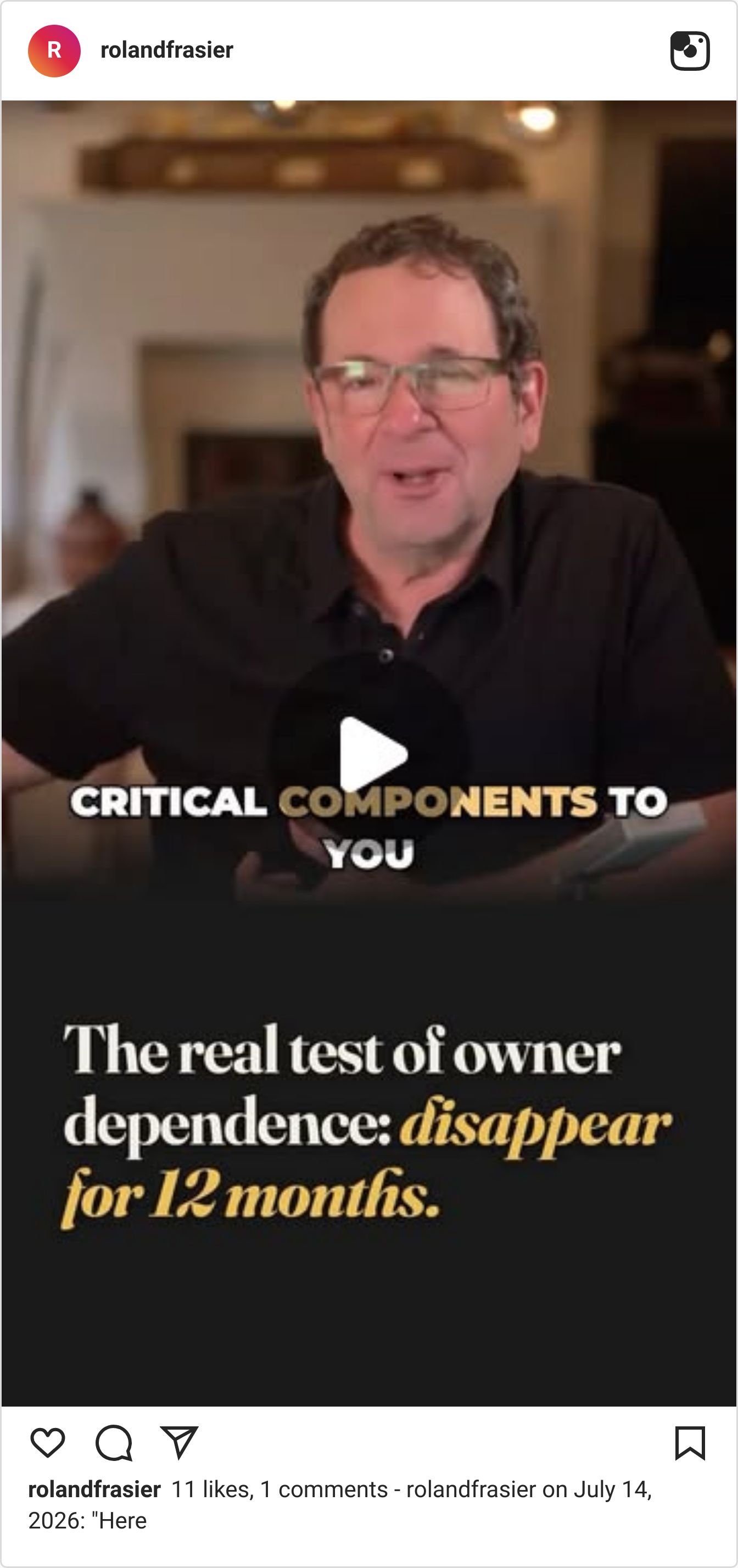
Most owners think their business can run without them.
Then I ask one question. "When you're not there... who does that?"
That's usually when the truth comes out.
The owner isn't "checking in once a week." They're still the head of sales. The key relationship. The final decision-maker. The person holding the whole thing together.
Buyers don't care how often you're in the office. They care whether the business still works when you're completely gone.
That's the difference between owning a company... and being the company's most important employee.
Want to see the one question that reveals whether your business is actually sellable? Watch the video below.