STRATEGY —
Meet Your Buyer Three Years Before You Sell
The process sets the ceiling. The relationships you built first set the floor.
TL;DR: Running a competitive process is still how you get the best price. Nothing beats bidding tension, and a single warm offer with no competition almost always comes in low. But what each buyer is willing to bid gets set before the auction starts, by how long they have known you. Strangers underwrite you as risk. Buyers who have watched you operate underwrite you as certainty, and they pay for fit a stranger cannot see. So build relationships with your natural acquirers years early, without ever signaling you are for sale. Then run the process anyway. The relationships set the floor. The process sets the ceiling.

The Process Only Prices What Buyers Already Believe
Let me say the quiet part first. When you sell, you run a competitive process. You hire the banker, you build the list, and you make buyers bid against each other, because nothing raises a price like another bidder in the room. The founders who take the one warm offer without shopping it are the ones who leave millions on the table. Buyers know this better than anyone. It is why the buyer who already knows you will push to preempt your process. They are not doing you a favor. They are trying to buy you without competition.
But a process has a ceiling nobody talks about. An auction does not create conviction. It only prices the conviction that walks in the door. Ninety days, a data room, and a diligence list built to find reasons to pay less. That is not enough time for a stranger to start believing you. A room full of strangers bids like a room full of strangers. Carefully. Low. Protected.
The variable that separates a hot process from a flat one is not your EBITDA. It is how long the people bidding have known your name.
I see this pattern hold across deal after deal. The seller who gets the premium did not just run the cleanest process. They walked into it with buyers who already wanted to own the business before the banker ever called.
A Stranger Underwrites You as Risk
Here is what actually happens inside the buyer's head. A buyer cannot pay for what they cannot verify, and in a ninety-day process there is only so much they can verify. So they price the rest as risk. Every number they cannot yet believe, every relationship they cannot yet confirm, every process they cannot yet see documented gets discounted, because the discount is the only protection they have against being wrong.
A buyer who has watched you operate for three years has already done that verification, slowly, in public, with no clock running. They have seen you keep a promise to a customer. They have seen you handle a bad quarter. They have watched your numbers behave the way you said they would. When they finally underwrite you, they are confirming a belief they already hold, not forming one under time pressure. Same business. A very different price, because one buyer is pricing certainty and the other is pricing the unknown.
This is the quiet mechanism behind so many "why did they pay so little" stories. The seller assumes the low number was about the business. It was about the stranger. The business was fine. Nobody in the room had known it long enough to believe it.
They Price You Against Their Portfolio, Not on Your Own
There is a second thing a known buyer does that a stranger cannot. They price you against their own portfolio.
Founders value their business on its own terms, as a standalone thing worth some multiple of its earnings. A strategic acquirer never sees it that way. They see what you become once you are inside their company. The customer list they can sell into. The capability they would otherwise have to build. The competitor they no longer have to fight. That fit is worth real money, but only a buyer who understands your business well enough to see the fit will pay for it. A stranger in a data room does not have time to imagine the synergy. A buyer who has known you for three years has been imagining it the whole time.
So the founder with no relationship to their natural acquirers is not just underwritten more harshly. They are quietly capped at the standalone price, because the only people who would pay the strategic premium do not know them well enough to offer it.
How You Build It Without Ever Signaling You Are For Sale
Here is the part founders get backwards. They think building buyer relationships means signaling they are for sale, so they avoid it, because looking for an exit looks like weakness. It does. That is exactly why you do not do it that way.
You build the relationship by being useful to the people who would one day acquire you, years before there is anything to sell. The strategic acquirer in your category. The private equity (PE) platform quietly rolling up your space. The larger competitor who envies the one thing you do better than they do. You share market intelligence. You send a referral their way. You take the meeting at the conference. You partner on the small thing that helps you both. None of it says you are selling. All of it means that when you finally hand a banker your buyer list, it is full of people who have watched your business be real for three years, not strangers being asked to trust you on a ninety-day clock.
The work happens on a calendar you cannot get back later. Three years out you have leverage, because you need nothing. You are building relationships as a peer, from strength. Six months out, when an offer is already on the table, every one of those conversations is impossible to start honestly, because now you obviously need something and everyone can see it. The founders who get the best price built their buyer list when they had no reason to.
Then, when the day comes, you still run the process. This is the part that matters. The relationships are not a substitute for the auction. They are what you feed into it. A known buyer with no rivals at the table has no reason to pay a premium, which is exactly why known buyers try to preempt. So you take the three relationships you spent years building and you put them in the same process, bidding against each other, each one pricing certainty instead of risk. The banker's job is to manufacture tension in ninety days. Your job, done years earlier, is to make sure the tension starts high.
My Perspective
So the question worth sitting with this week is a short one. If you decided to sell in three years, who would you call? And do they already know your name?
If the honest answer is that you would ask an advisor to go find someone, then you are planning to meet your most important buyer at the single worst moment to meet them. When you need them, when the clock is running, and when they know both.
The most valuable relationships in your eventual exit are the ones you build while an exit is the last thing on your mind. Start now, quietly, with the three people who would most want to own what you have built.
The auction you run in year three sets the ceiling. The calls you make this year set the floor.
— Roland

Want more than just the weekly deep dives?
On Instagram we share quick tips, behind-the-scenes looks, and first access to what’s coming next.
Follow @RolandFrasier on Instagram and join the community.

Thinking About Exiting Your Business?
What Would Buyers See If They Evaluated Your Business Today?
Your Exit-Ready Score reveals the hidden risks that suppress valuation, built on the same indicators private equity uses to screen deals in under 5 minutes.
Find out your score….

Roland’s Riff
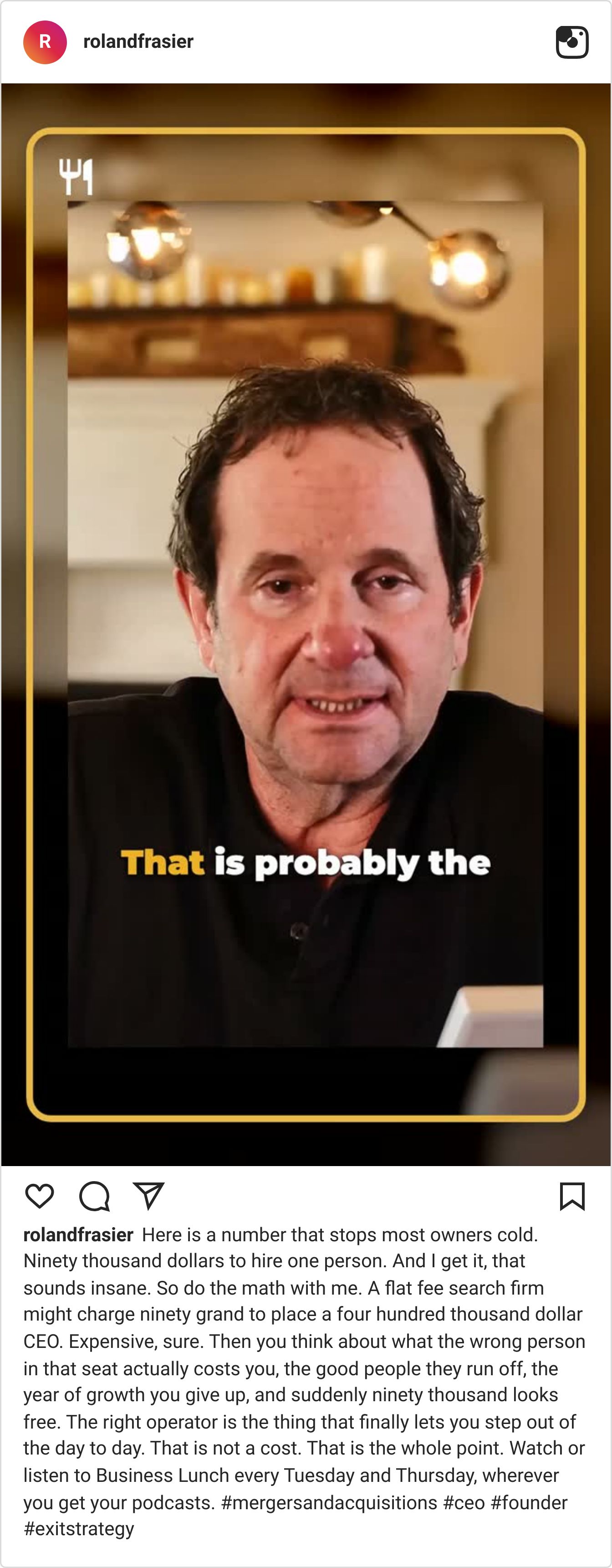
Here's a number that stops most founders cold…$90,000.
That's what some companies pay to hire one executive.
At first, it sounds outrageous.
Until you compare it to the cost of hiring the wrong one.
A single leadership mistake can quietly cost you far more than the search fee—in lost momentum, missed opportunities, and years of growth you'll never get back.
The best hires don't just improve your business.
They change your role inside it.
Want to see why great leadership is an investment, not an expense? Watch the video below.