SCALE —
How Buyers Judge Whether Your Business Can Run Without You
The difference between running a business and owning one
TL;DR: In the best-run businesses, a decision isn't just something that happened. It's something that exists as a record with context, rationale, and ownership. Founders who treat decisions as outcomes that disappear after the meeting stay trapped at the center of every "why" question. Founders who treat them as artifacts build organizations that think without them.

A Pattern Worth Noticing
There's a distinction I keep seeing between businesses that stay founder-dependent and businesses that break free of it, and it's subtler than most people expect.
It's not about the quality of the decisions being made. In most cases, the founder-dependent business is making perfectly good calls. The difference is what happens to those decisions after they're made.
In a founder-dependent company, decisions are outcomes. Something was decided, the team acts on it, and the reasoning lives in the founder's head. If anyone needs the context six months later, they ask the founder. If the founder isn't available, the team either guesses or waits.
In a professionally managed company, decisions are artifacts. They exist as durable records, short and simple, with the choice, the rationale, and the owner attached. Anyone can find them. Anyone can learn from them. They compound into institutional knowledge that doesn't depend on any single person's memory.
This sounds like an operational detail. It's actually a leverage distinction.
The founder who treats decisions as outcomes is always needed. Not because the team is incapable, but because the team has no access to the reasoning behind past choices. They can execute, but they can't extend. They can follow the pattern, but they can't adapt it, because the pattern was never made visible.
The founder who treats decisions as artifacts gives the organization something it can't get any other way: the ability to think in their absence. Not just do the work, but understand why the work is being done this way, and make intelligent adjustments when conditions change.
This isn't about building a bureaucracy. The best decision records I've seen are two or three sentences. What was decided, why, and who owns the follow-through. That's enough. The point isn't the format. The point is that the thinking is no longer locked inside one person's head.
And here's where it connects to value. When a buyer evaluates a business, they're not just buying current performance. They're buying the organization's capacity to sustain that performance without the founder. Decision artifacts are one of the clearest signals that the business has that capacity. Their absence is one of the clearest signals that it doesn't.
If you want to know whether your business can run without you, don't look at whether the team can execute. Look at whether the team can explain why they're executing it that way, without calling you.
— Roland
SCORE YOUR BUSINESS THE WAY I SCORE ACQUISITIONS
I've evaluated hundreds of companies for acquisition. Most aren't ready, and they don't know it.
Thursday I'm showing founders how I score them, and what it costs them when they score low.
$100. 90 minutes. Once it's done, it's done.

Want more than just the weekly deep dives?
On Instagram we share quick tips, behind-the-scenes looks, and first access to what’s coming next.
Follow @RolandFrasier on Instagram and join the community.

Thinking About Exiting Your Business?
You’ve built something incredible, now it’s time to make sure you get the most from your exit. We’ve helped countless entrepreneurs maximize their business sales, ensuring they walk away with more than just a deal, they walk away with the best deal possible.
Want to see what’s possible for you? Schedule a complimentary call today to see how I can help you get the most out of your exit.

Whats Going On Recently
Keep More Of Your Money: PRIME can show you how to protect yourself, grow assets, build business funding, and how to take advantage of 250+ unique tax deductions.

Zero Down Book | Free Copy
This Book Reveals Little-Known Wall Street Insider Strategy To Quickly Acquire Profitable Businesses Worldwide, Without Using Your Own Money or Credit...

Roland’s Riff
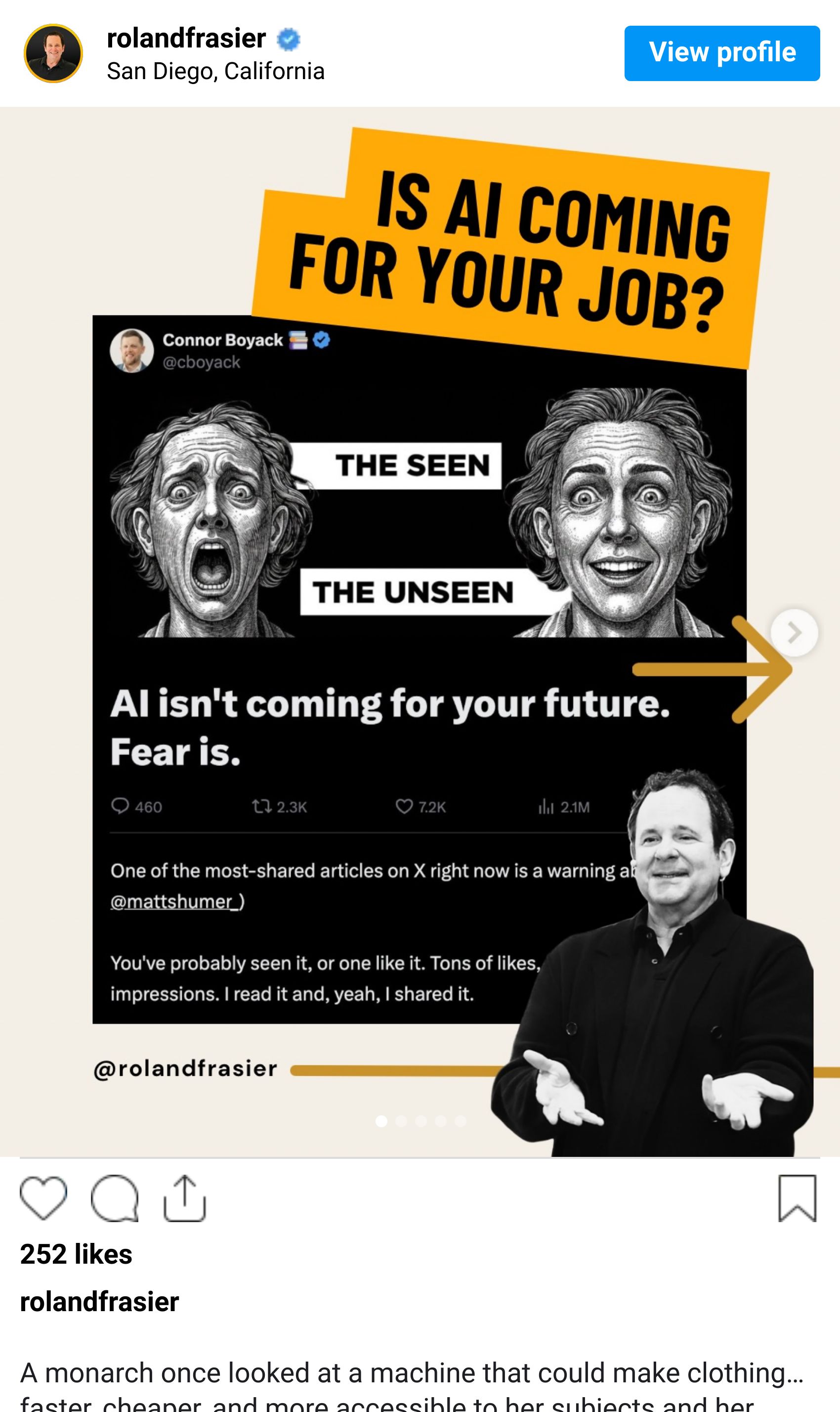
A monarch once tried to shut down a machine that made clothing faster and cheaper.
Not because it didn’t work, because it worked too well.
That same instinct is showing up again, just in a different form.
Every major shift creates the same reaction: hesitation, resistance, and a quiet fear of becoming less necessary.
But history is very consistent on what happens next.
The advantage doesn’t go to the ones who resist. It goes to the ones who reposition early.
Which side of this shift are you going to be on? Watch the video below.