STRATEGY —
You're Still Paying the Partner Who Quit
Dead equity compounds at exactly the rate your business does
TL;DR: Founders treat equity as the cheap currency because no cash leaves the bank when they grant it. It is the most expensive money they will ever spend, because it is the only expense in the business that compounds. The co-founder who left in year three still owns twenty percent of everything built from here forward. Nothing forces a founder to read the cap table until a buyer's counsel reads it for them, and that is the worst possible moment to discover the problem. The cheapest day to fix dead equity was the day it died. The second cheapest is today.

You're Still Paying the Partner Who Quit
Dead equity compounds at exactly the rate your business does.
Pull up your cap table. The actual document, not the version in your head.
If your company is more than a few years old, there is a decent chance someone on it stopped contributing a long time ago. The co-founder who left in year three and kept his twenty percent. The early employee who got five points and moved on. The advisor who made four introductions in 2021 and owns two percent of everything you have built since.
Founders treat equity as the cheap currency. No cash leaves the bank when you grant it, so it never feels like spending. It is the most expensive money you will ever spend, because it is the only expense in your business that compounds.
The math founders refuse to run
Say your co-founder left when the company was worth $400,000. His twenty percent walked out the door at $80,000. Annoying. Survivable. Today the business is worth $12 million. That same twenty percent is now $2.4 million. Your best employee earned $180,000 last year and worked for every dollar of it. The partner who quit earned more than ten times that in appreciation. For nothing. And if you grow next year, he gets a raise.
You are not paying him for the work he did. You are paying him out of every dollar of value you create from here forward.
Why nobody fixes it
There is no forcing function. Your P&L closes monthly. Your taxes get filed annually. Your cap table has no calendar. Nothing makes you read it, so nobody does. It sits in a drawer, quietly indexing dead weight to your growth rate.
I see this constantly. Founders who can recite their gross margin to the decimal and have not looked at their own ownership structure in four years.
When it stops being quiet
Speaking as a recovering attorney: the cap table gets read carefully exactly once, and it is read by the buyer's counsel during a transaction. That is the worst possible moment to discover the problem.
Because dead equity at exit is not just money. It is leverage. If your documents do not include drag-along rights (the contractual obligation for minority holders to join a sale the majority approves), then the partner who has not returned your calls in five years has a seat at your closing. I have watched deals re-traded and timelines blown because a ten percent holder nobody had spoken to in years decided his signature was worth negotiating over. The buyer reads that as risk. Risk gets priced. You pay it. Again.
The question worth asking
Every quarter you wait, the cleanup gets more expensive, because you are negotiating the buy-back against your own growth. The cheapest day to fix dead equity was the day it died. The second cheapest is today.
So look at the document and ask one question: who on this cap table created value in the last twenty-four months?
Anyone who didn't is not a shareholder. They are a royalty you volunteered to pay. On everything. Forever. Until you act.
— Roland

Want more than just the weekly deep dives?
On Instagram we share quick tips, behind-the-scenes looks, and first access to what’s coming next.
Follow @RolandFrasier on Instagram and join the community.

Thinking About Exiting Your Business?
What Would Buyers See If They Evaluated Your Business Today?
Your Exit-Ready Score reveals the hidden risks that suppress valuation, built on the same indicators private equity uses to screen deals in under 5 minutes.
Find out your score….

Whats Going On Recently
Keep More Of Your Money: PRIME can show you how to protect yourself, grow assets, build business funding, and how to take advantage of 250+ unique tax deductions.

Zero Down Book | Free Copy
This Book Reveals Little-Known Wall Street Insider Strategy To Quickly Acquire Profitable Businesses Worldwide, Without Using Your Own Money or Credit...

Roland’s Riff
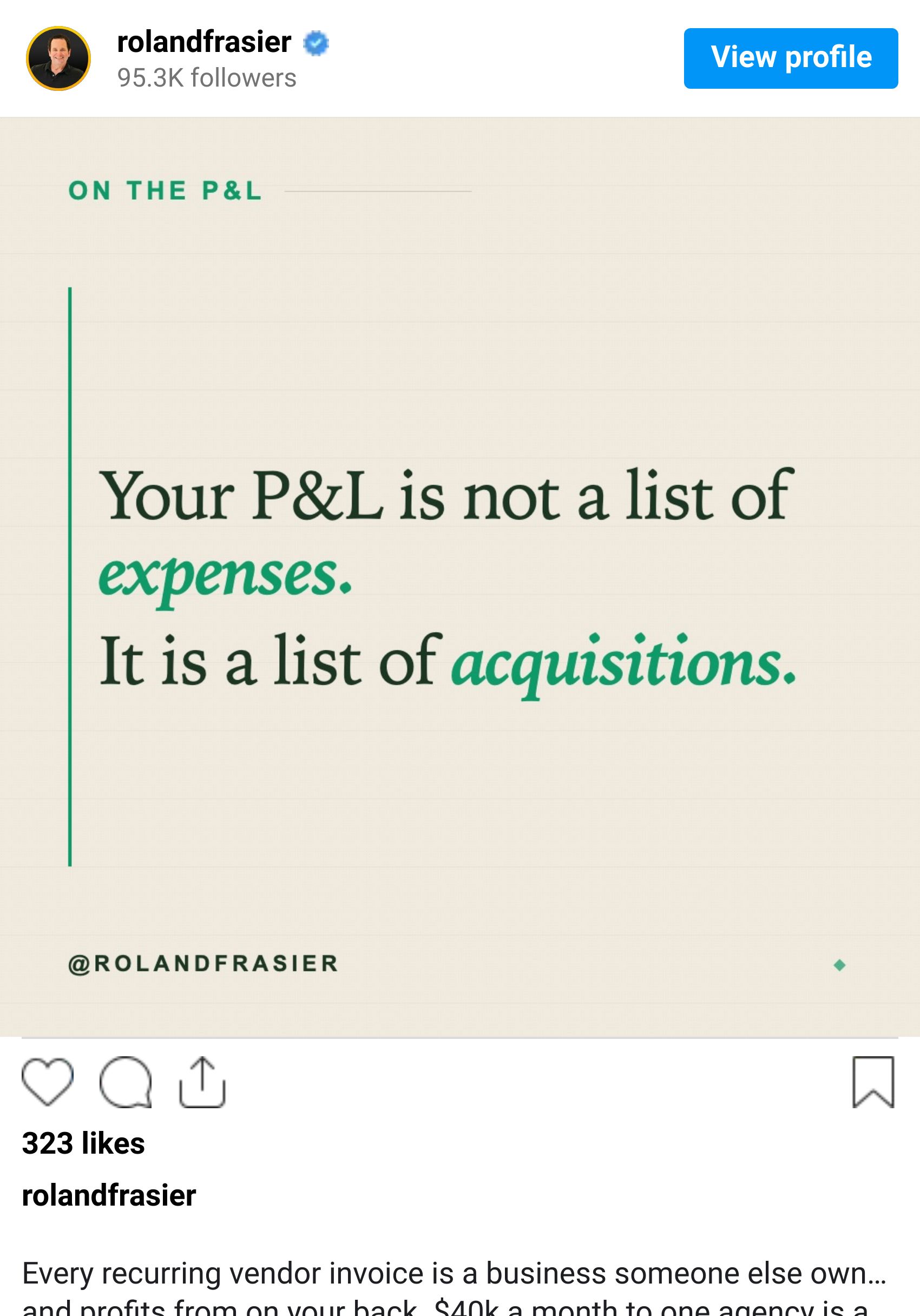
Most owners read their P&L the wrong way.
They see expenses, acquirers see opportunities.
Every recurring payment on your income statement is funding someone else’s business, someone else’s growth, and someone else’s equity value.
The question isn’t always, “How do I reduce this cost?”
Sometimes the better question is much bigger.
The way you look at a P&L changes completely when you stop thinking like an operator and start thinking like an acquirer.
Want to see how acquirers spot opportunities hiding in plain sight? Watch the video below.