STRATEGY —
Stop Sending Business For Free
Every referral you send another company is unpaid equity you never collected.
TL;DR: Founders send other businesses real, recurring value all the time, referrals, volume, introductions, and call it goodwill instead of what it actually is. I once used a referral relationship worth more than 10% of a company's revenue to negotiate a 20% equity stake for zero cash out of pocket, a move I call the Pipe Wrench. The tactic isn't complicated, it's just rarely used. Most founders are already creating enough value to own a piece of the businesses they're feeding, and never once ask for it.

The Relationship You're Not Pricing
Every founder has at least one business relationship like this. A vendor you send more volume to than anyone else on their client list. A referral partner you feed leads to every month without asking what happens to them after. A platform or marketplace where your traffic makes someone else's numbers look good.
It shows up in different shapes depending on the business. A referral partner. A key vendor you helped scale. An affiliate or reseller relationship you built out of convenience years ago and never revisited. The shape changes. What's underneath it doesn't: somebody else's revenue is growing because of something you're doing for free.
Most founders treat that flow as a courtesy. It isn't billed, it isn't tracked, and nobody on either side calls it what it actually is, a transfer of value out of your business and into someone else's, for nothing in return.
I don't think of it that way. If I'm sending a company enough business to move its revenue, that's not a favor. That's leverage I already own and haven't collected on.
What I Traded for 20 Percent
Here's a deal from my own playbook. There was a mail house, twenty-eight years old, doing about five million a year. Our companies were already sending it more than ten percent of its revenue in referrals, and had been for a while.
Instead of just letting that relationship keep running on goodwill, I asked for a piece of the business. We ended up with a twenty percent stake, worth roughly a million dollars, plus an earn-in of two percent for every additional million dollars of cash flow the relationship produced going forward. Cash out of pocket: zero.
I call this the Pipe Wrench. If you're constantly sending new business to another company, you ask them to give you part of their company in return for continuing to send business to them. That's the whole tactic. It isn't a negotiation trick. It's naming what you're already worth to someone and asking to be paid in the currency you actually want, which is ownership, not another thank-you email.
Do you already send another business real, recurring value for free?
Ask Before You Give It Away Again
Most founders never make this ask, not because it wouldn't pay off, but because the value never got named. Nobody sat down and calculated what a referral relationship is actually worth to the business receiving it. So it just runs, quietly, as an unbilled subsidy, year after year.
This isn't about souring every relationship into a negotiation. Most of them should stay exactly as they are. But at least once a year, it's worth asking the question honestly: is there a relationship in this business generating enough value for someone else that it would justify a piece of what they own? If the answer is yes and you've never asked, you're not being generous. You're leaving equity on a table you built.
The fix isn't a new source of leverage. It's noticing the one you're already operating. Look at where your business sends real, measurable value to someone else's, on purpose or by habit, and ask whether you've ever been paid for it in anything other than reciprocity.
If you're not sure where else in your business this kind of leverage is sitting unclaimed, the Acquisition Wheel maps it out, free, in a few minutes.
— Roland
Co-Founder, Scalable

Want more than just the weekly deep dives?
On Instagram we share quick tips, behind-the-scenes looks, and first access to what's coming next.
Follow @RolandFrasier on Instagram and join the community.

Thinking About Exiting Your Business?
What Would Buyers See If They Evaluated Your Business Today?
Your Exit-Ready Score reveals the hidden risks that suppress valuation, built on the same indicators private equity uses to screen deals in under 5 minutes.
Find out your score….

Roland's Riff
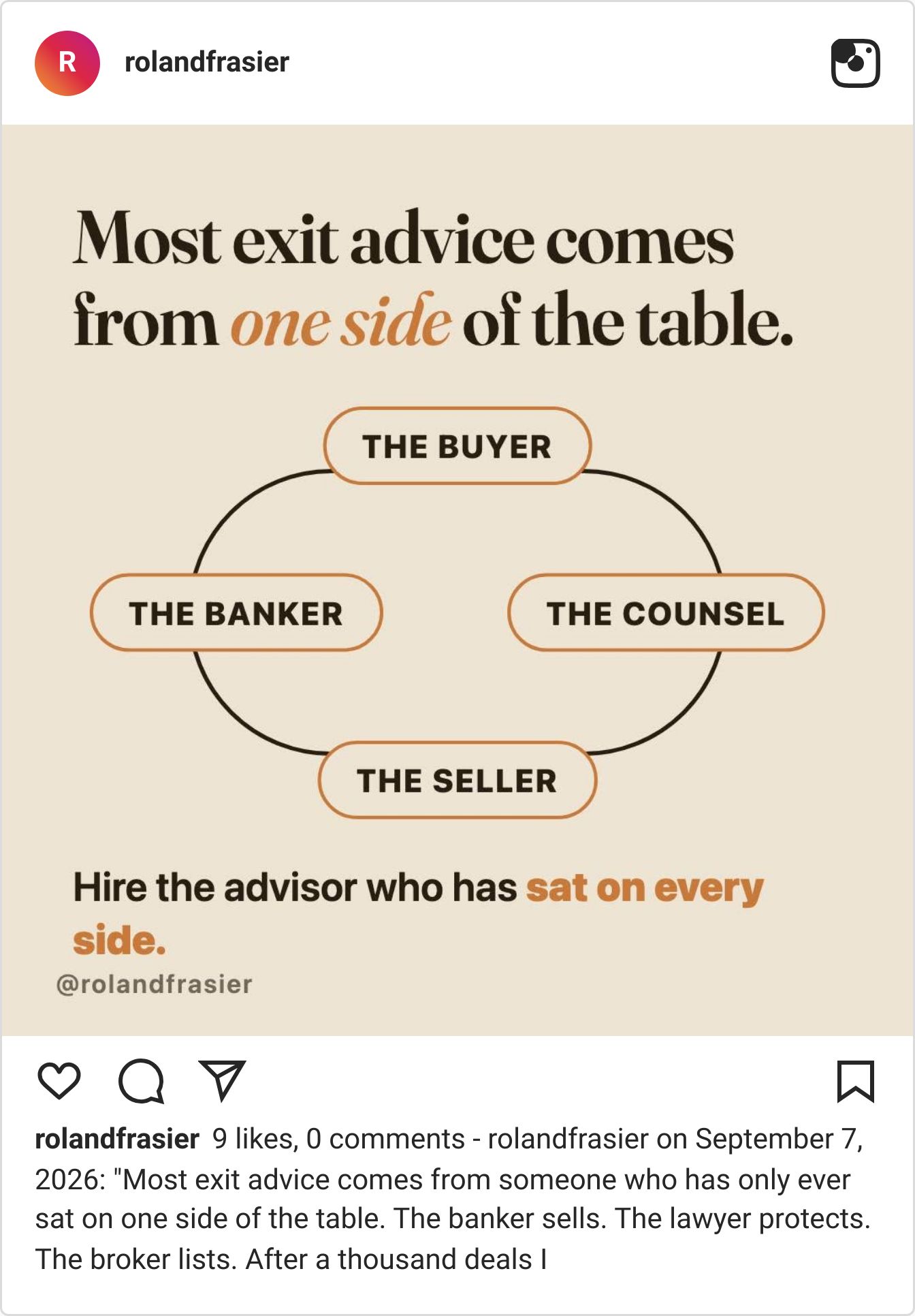
Most exit advisors have only ever sat on one side of the table.
And that matters more than most owners realize.
Selling a business looks very different when you've also been the person buying one.
You know where buyers push.
You know what makes them nervous.
You know what they're thinking when the seller leaves the room.
After more than a thousand deals, I've sat at the table as the buyer, the seller, and the counsel.
And there's one question I'd ask anyone before trusting them to guide my exit.
Want to know the question? See below.