STRATEGY —
The One Number You Actually Control
The one number you fully control is the one you treat as untouchable.
TL;DR: Founders will rebuild operations, re-engineer the org, and chase new markets. They will do almost anything but raise the price. Yet the price is the one number they control completely, and a customer's willingness to pay it is the clearest evidence they've built something defensible. Pricing power isn't about squeezing customers. It's a test of whether you have a moat, and most founders never run it. Buyers pay premium multiples for the business that commands its price, because that business has proven its margins are real and its demand is loyal.

The One Number You Actually Control
There's a strange blind spot in how founders think about their business. They'll spend a year re-engineering operations to find a few points of efficiency. They'll enter a new market, hire a new team, rebuild the funnel. Hard, expensive, uncertain work.
And the entire time, the one lever that's fully theirs, the one sitting right there, costing nothing to pull and flowing straight to the bottom line, is the price. They treat it as if it were handed down on a stone tablet. Set once, early, usually out of caution, and never seriously revisited since.
You don't control the market, your costs, or your competitors. You control your price. It's the cleanest lever you own, and most founders won't go near it.
You Set That Price When You Were Smaller and Scared
Here's the misconception: that the market sets your price, and your job is to come in under it.
Most founders priced their business years ago, when they were unproven and hungry, and the logic then was simple. Be cheaper, win the work, don't give anyone a reason to say no. That logic made sense when you had nothing. It quietly became your identity, and you never updated it. You're still pricing like the scrappy challenger long after you became the thing people actually want.
So you discount reflexively. You hold rates flat for years while everything you deliver gets better. You assume any increase sends customers running, and you never test the assumption, because the test feels dangerous.
Meanwhile your best customers, the ones who'd pay more without blinking, who chose you for reasons that have nothing to do with price, are quietly subsidizing the discount you give everyone else.
Pricing Power Isn't a Tactic. It's Evidence.
The reframe is this: raising your price isn't a money grab. It's a diagnostic.
The ability to raise prices and not lose customers is the single clearest proof that you've built a moat. It means people buy you for something other than being the cheapest.
They buy you for trust, results, switching cost, reputation, the simple fact that you're the one they want.
That isn't a pricing fact. It's an enterprise-value fact, and pricing power is how you find out whether you have it.
Most founders never run the test, so they never learn what they actually built. They assume they're a commodity and price accordingly, and the pricing makes it true. But the business that holds its price through a downturn, that raises rates and keeps its clients, that never apologizes for what it charges, has told you something no spreadsheet can.
It has demand that doesn't flinch. And demand that doesn't flinch is the rarest, most valuable thing a small business can own.
The Buyer Already Knows This
Here's why it matters even if you never plan to sell.
A serious buyer studies your pricing before almost anything else. Not the level, the power. Have you raised prices and held your customers? Do you discount to close, or do people pay your number? Is your margin the result of relentless cost-cutting, or of a brand people will pay up for? The answers tell the buyer whether your earnings are durable or fragile, and durability is most of what a premium multiple is paying for.
A business with real pricing power gets the premium, because the buyer can see the margins are defensible and there's still room to take price after the deal. A business that competes on price gets the discount, because the buyer assumes that the moment a tougher competitor shows up, the margins leave with it.
The pricing power you never exercised isn't neutral. It's value you're leaving on the table today, and a weaker story in the room tomorrow.
My Perspective
Pricing power is optionality in its purest form. A business that commands its price doesn't have to chase volume, doesn't have to win on being cheapest, doesn't have to run twice as hard for the same money. It earns from strength, which means it earns without you grinding for every dollar.
The goal was never to be the affordable option. It was to build something people want badly enough to pay for, and then to have the nerve to let them. Test the price. The number that comes back is one of the truest measures you'll ever get of what you've actually built, and of what it's worth without you.
— Roland

Want more than just the weekly deep dives?
On Instagram we share quick tips, behind-the-scenes looks, and first access to what’s coming next.
Follow @RolandFrasier on Instagram and join the community.

Thinking About Exiting Your Business?
What Would Buyers See If They Evaluated Your Business Today?
Your Exit-Ready Score reveals the hidden risks that suppress valuation, built on the same indicators private equity uses to screen deals in under 5 minutes.
Find out your score….

Whats Going On Recently
Keep More Of Your Money: PRIME can show you how to protect yourself, grow assets, build business funding, and how to take advantage of 250+ unique tax deductions.

Zero Down Book | Free Copy
This Book Reveals Little-Known Wall Street Insider Strategy To Quickly Acquire Profitable Businesses Worldwide, Without Using Your Own Money or Credit...

Roland’s Riff
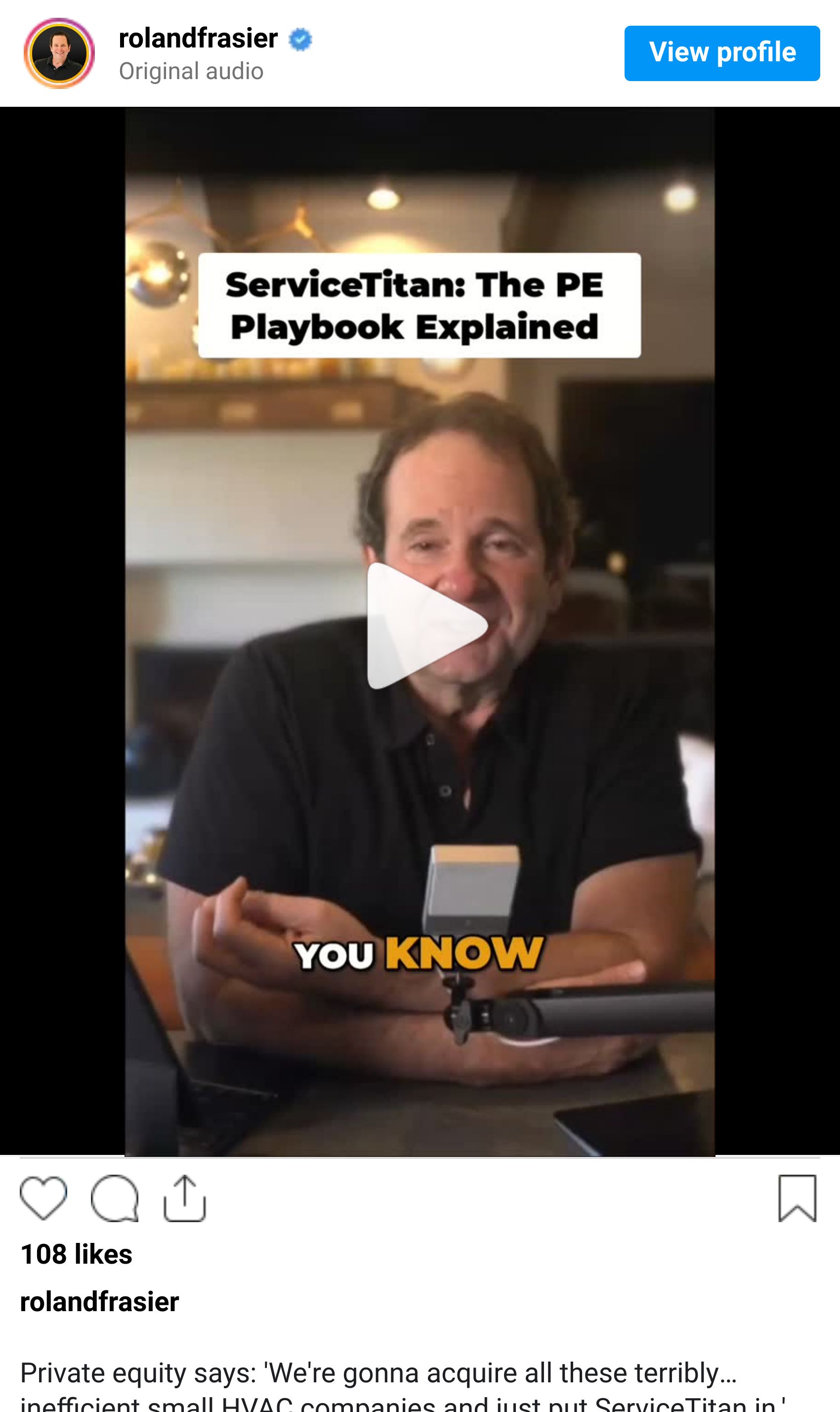
Private equity isn’t buying companies.
They’re buying transformation opportunities.
Most people look at acquisitions and see bigger companies being built.
The best investors see something else entirely: operational inefficiencies that can be turned into value.
Size matters.
But size without improvement is just a larger version of the same problem.
The real money gets made when you combine acquisition with transformation.
Want to see why operational improvements can be worth more than the acquisition itself? Watch the video below.