STRATEGY —
The A-Player Trap
The impressive hire scales your costs. The right one owns a number.
TL;DR: Plateaued founders reach for the big-company A-player as the fix, and the hire usually backfires. Executives who excelled inside unlimited budgets solve problems with headcount and tools, cost twenty times their salary, and clash with the mentality of ownership, because it is not their company. The alternative is the tier most companies never build: micro owners, operators who own one metrics-based outcome with real autonomy and upside tied to their own unit. The founders who scale without bloat are not collecting rockstars. They are converting roles into owned numbers.

The Reflex Hire
Every plateaued founder eventually has the same thought. The business works, growth has slowed, and the diagnosis writes itself: what this company needs is real talent. A proven executive. An A-player from a company ten times our size, someone who has already seen the movie we are trying to make.
It feels like the responsible move. It is usually the expensive one. Not because talent does not matter, but because talent is not context-free. The A-player you are about to hire was built by a context you do not have, and cannot afford to recreate.
What the Résumé Does Not Transfer
A while back I sat in interviews for one of our portfolio companies, a business with about 200 employees. The candidate was genuinely exceptional. She came from a company she had helped grow from $800 million to $3 billion, where she ran a 600-person organization. We asked what she would do in her first 90 days. Her answer: staff up. In her assessment, we were horribly understaffed.
She was not wrong by her map. She had excelled inside very well-funded guardrails, with something close to an unlimited budget. That environment produced her instincts. Which is why everything she costs is a times 20. She will fix all the things, and she will fix them with lots and lots of people and lots and lots of tools.
The pattern repeats at every seat. Hire the A-player CFO (Chief Financial Officer) and watch the finance department follow: a controller, a head accountant, assistants, an FP&A (financial planning and analysis) person. Bang: six or seven people where you used to have a bookkeeper and a fractional CFO.
Sometimes it costs more than payroll. I watched a software company with multiple seven figures of EBITDA (earnings before interest, taxes, depreciation, and amortization) hire a credentialed CEO with multiple exits behind him. The enterprise playbook did not work in a small-business environment, and the contract the founders signed in the honeymoon phase meant they had to buy him out at a price that hurt, right off the bat.
Underneath the war stories is a mentality gap. Big-company A-players are management operators, not entrepreneurs. They think in processes that are replicable and repeatable, and they think in contracts. I have heard it put almost exactly this way: my contract says I work four days a week, and I will absolutely sue you to enforce it. That is not villainy. It is a rational position for a hired gun. But it is not your position, because it is not their company. It is yours.
The Tier Everyone Skips
On a recent episode of Business Lunch, Ryan Deiss and I dug into where this goes instead, and the useful frame is a middle tier most companies never build.
At the bottom of most org charts, people manage to a task. The task is binary: done or not done. At the top, a few people own strategy. The standard fix for growth is to stack managers in between, people whose job is to manage the people doing the tasks. That is how headcount compounds without leverage.
The alternative is what we have been calling the micro owner: an operator given real end-to-end sovereignty over one distinct piece of the business, a unit, a product line, an acquisition funnel, and measured not on tasks completed but on the profitability and capital efficiency of their specific pot. They own a number. How they hit it is theirs to assemble.
The definition only holds if the autonomy is real. If you will not let them make the calls inside their unit, they are not an owner. They are an employee with a better title. And ownership needs owner-like upside. There are clean ways to structure that upside tied only to their unit, without handing over company equity, and those mechanics are worth their own letter. For now, one warning from the equity side: the equity you grant an A-player at this stage may be the most expensive equity you ever give.
The Hire That Still Works
I have written before that a single right management hire can transform what a business is worth, and I stand by it. The two positions are not in tension. The hire that works owns an outcome inside your context. The hire that fails imports another company's infrastructure into yours. One is buying leverage. The other is renting someone else's overhead.
The distinction matters more right now than it has in years, because the biggest companies are stripping out their management layers, and those people are landing in your inbox.
In Korn Ferry's survey of 15,000 professionals worldwide, 41 percent said their company trimmed management layers in the past year. On paper, from the outside in, those people look exactly like A-players. Many are the opposite of what you need: no longer in the doing, not yet at the point of leading, formed by the comfortable middle. The labor market is about to make the wrong hire look affordable at precisely the moment it is most wrong.
There is also a quiet alignment problem nobody prices in. A manager is structurally incentivized to accumulate: more reports, more budget, more surface area. A micro owner is aligned with you in flattening the company, because a flatter unit is a more profitable number, and the number is theirs. When promotion follows outcomes delivered instead of headcount managed, the whole organization gets more competitive, not just cheaper.
My Perspective
The goal was never to collect impressive people. It was to build a business that does not need heroes, including you. A company staffed with hired guns runs on your supervision, your culture translation, and your contract lawyers. A company of owned numbers runs on incentives, which is the only thing that scales without you.
So before you pay up for the résumé, count something simpler. Look down your org chart and ask how many people own a number, all the way through, with real room to move. If the answer is none, the next A-player will not fix that. The next owner might.
— Roland

Want more than just the weekly deep dives?
On Instagram we share quick tips, behind-the-scenes looks, and first access to what’s coming next.
Follow @RolandFrasier on Instagram and join the community.

Thinking About Exiting Your Business?
What Would Buyers See If They Evaluated Your Business Today?
Your Exit-Ready Score reveals the hidden risks that suppress valuation, built on the same indicators private equity uses to screen deals in under 5 minutes.
Find out your score….

Roland’s Riff
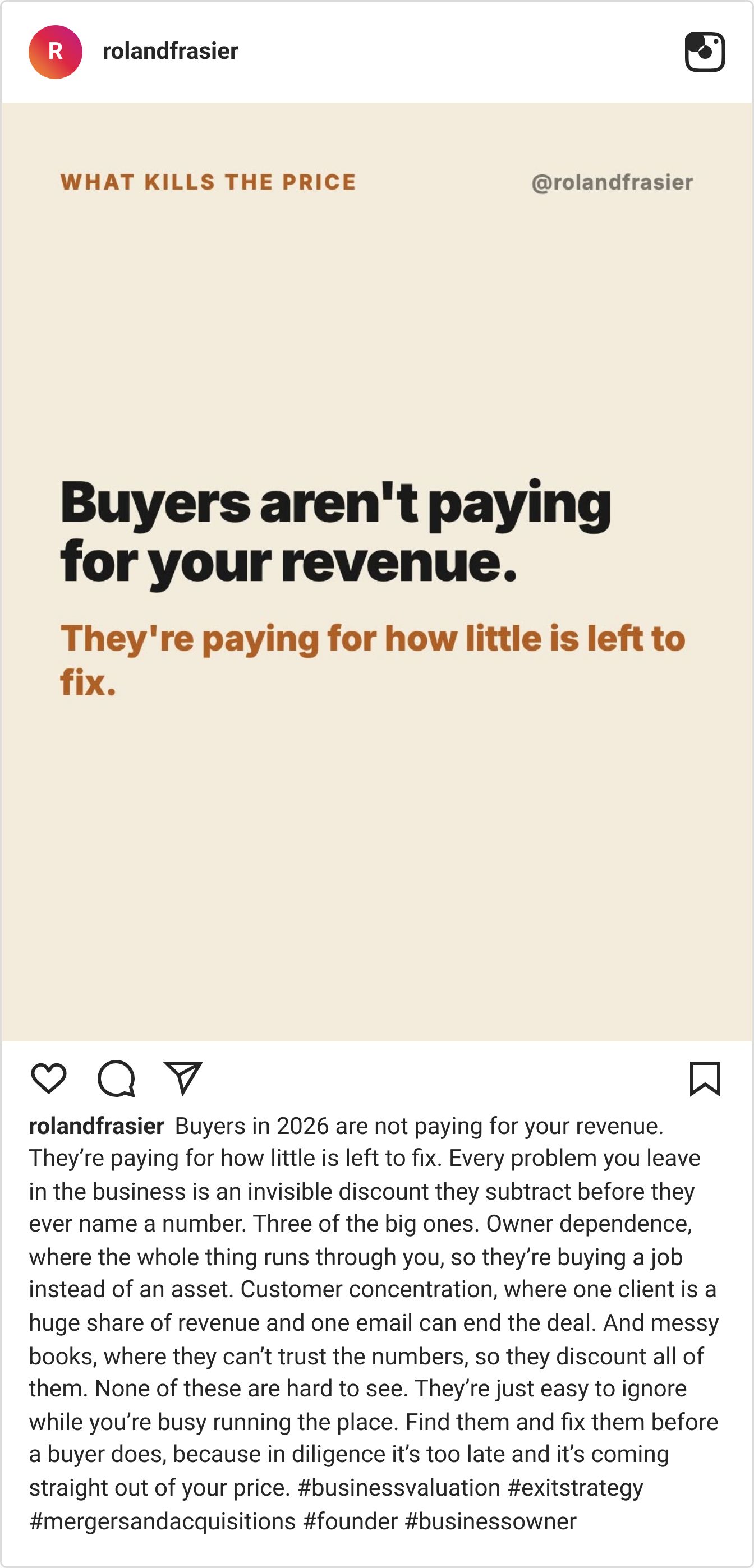
The biggest discounts in an acquisition never show up on a financial statement.
They show up in due diligence. Most owners think buyers are paying for revenue or profit.
They're not…They're pricing how much work is left after the deal closes.
Every unresolved issue quietly chips away at your valuation long before an offer is made.
The businesses that command premium multiples aren't perfect.
They've simply removed the biggest reasons for a buyer to hesitate.
Want to see the problems buyers discount before they ever make an offer?